 info@fitculture.ca
 (905) 669-7500


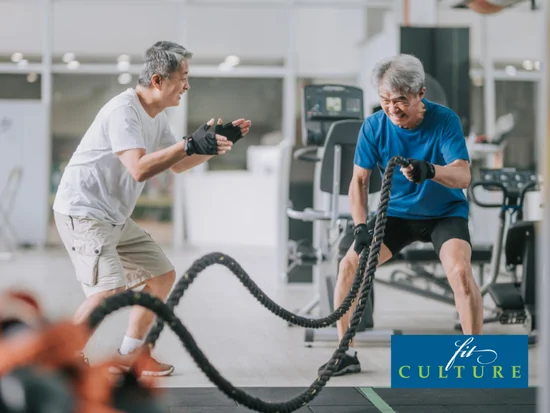
A lot of people over 50 assume strength training is something they have missed the window on, or that it needs to be replaced with something gentler.
Neither is true.
What changes is how the training is organized. The principles stay the same. The way you apply them needs to account for where you are now rather than where you were at 30.
Here is what actually shifts, and what does not.
What Does Not Change: Your Body Still Adapts
Muscle responds to resistance training at every age. Strength improves when you give your body a reason to get stronger, and it maintains when you do not.
This is the part that often gets lost. Programs marketed to people over 50 sometimes reduce to light weights, high repetitions, and very little challenge. That approach is comfortable, but it does not give the body much to respond to.
Meaningful strength work should still feel like work. What changes is how you build up to it and how much recovery sits around it.
What Does Change: Recovery Needs More Room
Recovery is usually the first thing that needs adjusting.
Training hard three days in a row may have been manageable years ago. It may not be now, and that is not a sign you should train less. It is a sign the schedule needs different spacing.
That might mean:
- Two or three sessions per week rather than five
- A full day between strength sessions
- Longer rest periods between sets
- More warm-up time before the first working set
Training frequency is a variable like any other. Adjusting it is part of a good program, not a compromise.
Warm Ups Stop Being Optional
Walking in cold and starting with your heaviest set is a habit that tends to catch up with people.
A proper warm up prepares the joints and tissues you are about to load, and it gives you a chance to notice how you feel that day. Some days you will find you can push. Other days you will realize a lighter session makes more sense.
That information is useful. It only shows up if you take the first ten minutes seriously.
Technique Carries More Weight Than It Used To
Learning to perform exercises well is worth the time at any age. After 50, it matters more, because the margin for repeating a poor movement pattern for months is smaller.
The difficulty is that most technique problems do not feel wrong while they are happening. Watching a video shows you what an exercise should look like, but it cannot tell you what you are actually doing.
An outside perspective closes that gap. Small changes to stance, positioning, or range of motion can change how a movement feels and how well it works.
Over time, that also builds confidence. Instead of second-guessing whether you are using something correctly, you develop skills you carry into every future session.
Progression Still Applies
Repeating the same workout indefinitely eventually stops producing change.
Progression does not have to mean adding weight every week. It can mean:
- More repetitions at the same load
- Better control through the full range of motion
- Shorter rest between sets
- A harder variation of a movement you have got comfortable with
The point is that the demand increases gradually while recovery stays adequate. That balance is what keeps progress going without accumulating problems.
Consistency Beats Intensity Over the Long Run
Strength gained over years comes from sessions that keep happening, not from occasional hard weeks.
There will be periods with more time and periods with less. Travel, family, and busy stretches at work all interrupt routines. A plan that only works when everything goes smoothly is a plan that stops.
The useful approach is to reduce rather than pause. Four sessions become two. Sessions get shorter. The routine continues in a smaller form until the schedule opens up again.
Continuity is what protects the progress you have already built.
Progress Is Easier to See When Someone Tracks It
People consistently underestimate how much they have improved.
An exercise that feels routine today may have been genuinely difficult six months ago. Without a record, that improvement disappears.
Tracking loads, repetitions, and how sessions feel gives you evidence during the stretches when progress seems slow. It also makes it clear when something needs to change rather than leaving you guessing.
Build Strength That Lasts With Fit Culture Inc.
Fit Culture Inc. offers Silver Strength: Core and More, a program for people who want to train seriously without following a routine designed for someone half their age. Training takes place in a private studio in Concord, serving Vaughan, Thornhill, and the surrounding area, with programming adjusted to your starting point, your schedule, and how you recover. Book a free session to talk through what a week of training would look like for you.

- Big Box Gyms vs. Private Studio: The Honest Pros and Cons - September 22, 2026
- 5 Signs It’s Time to Hire a Personal Trainer - August 27, 2026
- Strength Training After 50: What Changes and What Doesn’t - August 21, 2026